From May 4 to May 22, 2025, the Hallelujah Gallery at ANU – Museum of the Jewish People – will showcase a remarkable spiritual treasure from the Beta Israel community: the Orit of Qes Abba Yitzhak Eyassu. The Orit is on display courtesy of the National Library of Israel.
This special exhibition is part of the academic program The Orit Guardians, led by the Department of Biblical Studies at the Rosenberg School of Jewish Studies and Archaeology at Tel Aviv University, in collaboration with the Koret Center for Jewish Civilization. The program explores the sacred texts of Beta Israel, focusing both on their ancient manuscripts and the living oral traditions of prayer, translation, and interpretation passed down through generations by the Qesočč – the spiritual leaders of Ethiopian Jewry.
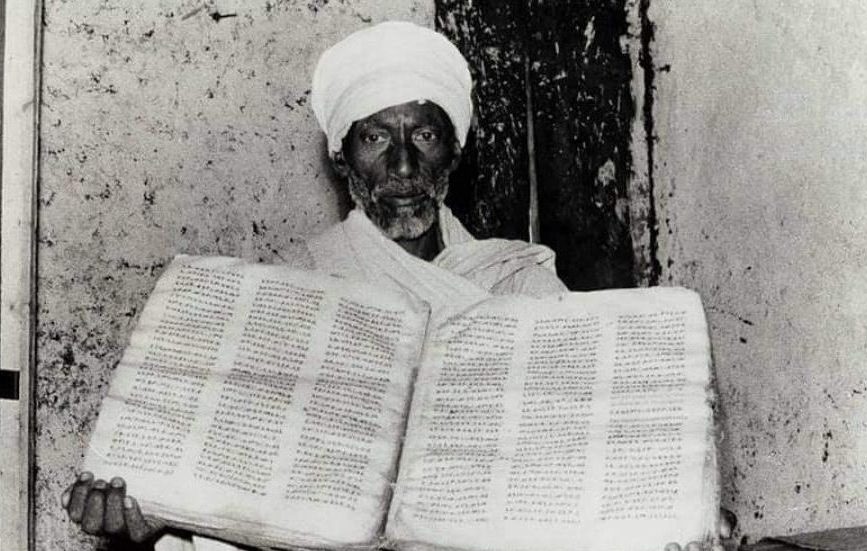
The Orit (ኦሪት) – a Ge’ez word also used in Amharic and Tigrinya – refers to the eight holiest books of the Ethiopian Bible: the Five Books of Moses, along with Joshua, Judges, and Ruth. These texts are preserved in codex form: hand-bound volumes with wooden covers and parchment pages made from goat or sheep skin.
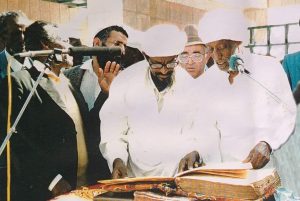
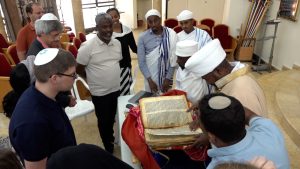
During public readings, the Qesočč would translate the Ge’ez text into Amharic or Tigrinya, the spoken languages of the Beta Israel community. As they translate, they add explanations, commentary, and cultural context, transforming the readings into powerful, communal spiritual experiences. These oral interpretations were never written down but were passed from teacher to student, held in the memory of a few elder Qesočč trained in Ethiopia.
The Orit on display belonged to one of the most revered spiritual leaders of the community, Qes Abba Yitzhak Eyassu (1900–1995), who served in the Tigray region for decades. Originally, the manuscript was purchased by Abba Warqah around the mid-19th century. He was the one who added a composition at the beginning of the Orit (titled The Life of Moses), and he, along with others after him, appended several additional texts at the end of the manuscript.
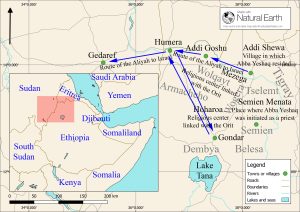
A map of sites associated with Qes Abba Yitzhak, prepared by Dr. Bar Kribus
Among these are two genealogical lists recounting how the book was passed on—first among Abba Warqah’s “spiritual sons” (i.e., his students), and later, after it came into the possession of Qes Eyassu, he entrusted it to his son Abba Yitzhak upon his ordination as a Qes (in 1927). As the owner of the manuscript, Abba Warqah inscribed the following curse formula in a special cryptic script, in which half the letters appear on one side of the page and the other halves on the opposite side: “This is the Orit of Abba Warqah, who purchased it for thirty shamama (a special type of cloth); whoever steals it or erases it shall be cursed with the words of Moses and Aaron.”
At age 82, in 1982, Abba Yizhak embarked on a perilous journey to Israel with his family – and the Orit in hand. The path led them through forests, over raging rivers, and across borders, all while facing dangers like robbers, arrests, and the constant threat of losing their sacred texts. Families went to great lengths to protect the Orit, hiding it among their few belongings, clothing, or even carrying it in secret.
These sacred books – especially the Orit – remain vital to the Ethiopian Jewish community today, used in celebrations, study, and religious ceremonies.
Kes Abba Yitzhak always believed the Orit’s true home was in the Land of Israel. In 2017, his family fulfilled that vision by donating the manuscript to the National Library of Israel, preserving it as part of the shared cultural heritage of the Jewish people.
Now, in this special exhibition, the public has a rare chance to encounter this extraordinary manuscript up close and discover the powerful story of the community that carried it across continents – and generations – with unwavering devotion.